The pattern is familiar enough to be a joke. You download a focus timer on Sunday evening, full of intent. Monday you run four sessions. Tuesday, three. By Thursday you open it once, stare at the start button, and close it. The following week the icon is still on your home screen and you never touch it again.
It is worth asking why, because the failure is remarkably consistent across apps that look nothing alike.
A countdown has nothing on the other side
Strip a focus timer to its function and you get: a number goes down, then a sound plays. Everything that makes the session worth doing — the essay written, the chapter read, the feeling of a day used well — happens outside the app. The app contributes the boundary and nothing else.
That is fine while motivation is high. Motivation is high for about four days.
What is missing is the part behaviour research is fairly consistent about: an immediate consequence. Distant rewards — better grades in three months, a finished thesis next year — are too far away to compete with a phone that pays out in under a second. The reward for finishing a focus session arrives weeks after the effort, and the reward for abandoning it arrives now.
Most timers measure your effort. Very few respond to it.
Streaks help, until they break
The common fix is a streak counter, and it does work — for a while. A number that climbs is a consequence you feel today, and losing it stings.
The problem is what happens the first time you miss. A streak is a brittle record: it is perfect or it is zero. People who miss a day after three weeks often do not restart at all, because the thing they were protecting is already gone. The mechanic that kept them going is the same one that makes quitting feel reasonable.
A streak worth having needs a cushion — a freeze, a rest day, something that lets a bad Tuesday stay a bad Tuesday instead of becoming the end of the habit.
Guilt is a poor engine
The other common fix is punishment: a tree that dies, a plant that withers, a fee you pay if you look at Instagram. It is effective at first and unpleasant over time, because it makes the app something to avoid. An app you feel guilty opening is an app you stop opening.
There is a real difference between a consequence and a punishment. A consequence gives you information — this session was abandoned, so nothing grew. A punishment adds shame on top, and shame is a famously bad long-run motivator for the exact behaviour you are trying to build.
What to look for instead
If you are choosing a focus app with the intention of still using it in three months, the questions worth asking are not about features:
- Does anything happen when I finish? Not eventually — right then, in the app, in a way I can see.
- Can I recover from a bad week? Or does the app quietly punish me for one miss until I give up.
- Does it interrupt the thing it is for? An advert between you and a focus session is the clearest possible signal about what the app is actually for.
- Can I change the interval? A fixed 25 minutes fits some tasks and fights others.
- Is my history mine? If you cannot export it, you are renting your own record.
What we built, and why
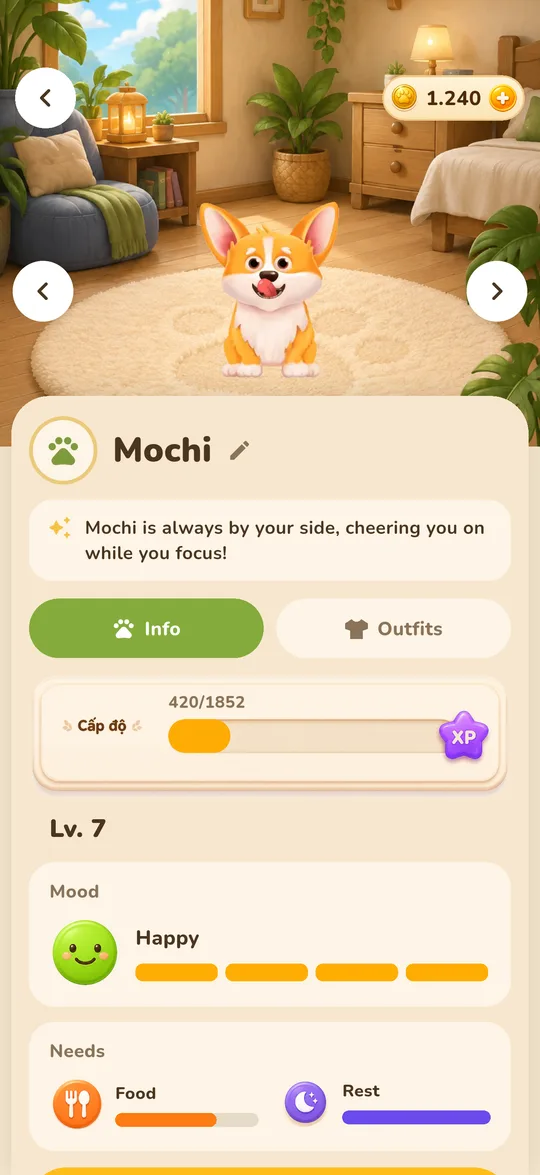
Study Corgi puts something on the other side of the session: a pet that reacts. Finish and it celebrates. Abandon one and it is visibly unhappy — and the coins you would have earned do not arrive. Those coins buy furniture and rooms, so a month of real focus turns into a room that looks like a month of real focus.
We are deliberate about the two failure modes above. The pet's reaction is a consequence, not a guilt trip — it recovers, and so can you. Streaks have a freeze so one missed day does not erase three weeks. And no advert ever appears while a session is running, which for a free app is a cost we accept rather than a feature we brag about.
None of this makes the work easier. It makes coming back tomorrow easier, which over a term turns out to matter more.

A timer with something on the other side
Pomodoro, deep work or count-up. A corgi that notices whether you finished, and a room that fills up as you go.
Have a look