Every term starts with a plan that assumes good days: three hours each evening, a colour-coded timetable, weekends for revision. It holds until the first genuinely bad week — illness, a deadline collision, a fight with someone, a run of poor sleep — and then it does not just bend, it disappears.
The fix is not more discipline. It is designing for the bad week from the start.
Set a minimum, not a target
A target is what you hope for. A minimum is what you do regardless. Pick something small enough that you would be embarrassed to skip it: one 15-minute session a day is a reasonable starting minimum for most people.
On good days you will do far more, and that is fine — but the minimum is what you are actually committing to, and what you measure. The point is that the chain never breaks, because a chain that never breaks does not need to be restarted, and restarting is where most people quit for good.
If your routine only works on days you feel motivated, it is not a routine. It is a mood.
Anchor it to something that already happens
"Study in the evening" fails because the evening has no edge. "Study right after dinner, at the kitchen table" works better, because dinner already happens at a predictable time and place.
Pick an anchor that occurs daily and is hard to skip: after breakfast, after the commute home, immediately after your last class. The routine borrows the reliability of the anchor. You are not building a new habit from nothing — you are attaching one to a habit that already survives bad weeks.
Decide the first task the night before
A surprising amount of avoidance happens in the thirty seconds after you sit down, while you work out what to do first. That gap is where the phone wins.
Close each session by writing one line: the exact first thing you will do next time. Not "revise chapter 4" but "do questions 1 to 5 on page 88". Tomorrow you sit down and there is nothing to decide, so there is nothing to avoid.
Protect the first ten minutes, not the whole session
Attention has a warm-up. The first ten minutes are the expensive ones — that is when the task feels unpleasant and the brain shops around for something easier.
So spend your defences there. Phone in another room, not face-down on the desk. Notifications off before you start, not after the first one arrives. On Android, apps can be shielded for the length of a session; on iOS the system does not allow that, so a physical barrier — the other room — does the job better than any app can.
After ten minutes, the task usually stops feeling heavy and the defences matter less.
Plan the recovery, before you need it
You will miss a day. The question is what happens next, and it is worth deciding now while you are calm rather than then, while you feel like a failure.
A rule that works: never miss twice. One missed day is weather. Two missed days is the start of a new pattern. If you miss, the next day's session can be the smallest possible version — ten minutes, the easiest task on the list — but it happens.
Notice what this rule protects: not your productivity, your identity. The story "I study daily, though I missed Tuesday" survives. The story "I used to study daily" does not come back easily.
Review weekly, and be honest about the numbers
Once a week, look at what actually happened rather than what you intended. Total time is the least useful number. More useful:
- Days you started at all. Six out of seven is a good week, even if three of them were fifteen minutes.
- When your good sessions happened. Most people have one or two hours a day when focus is cheap. Find yours and defend it.
- Which tasks you kept postponing. A task pushed three weeks running is not a scheduling problem; it is unclear, too large, or you are missing something you need to ask about.
A starting routine, written out
- Minimum: one 15-minute session, every day.
- Anchor: immediately after dinner, at the same desk.
- First task decided the night before, written down as one line.
- Phone in another room for the first session.
- Never miss twice; the recovery session may be tiny.
- Sunday: five minutes to count the days you started and pick the week's anchor tasks.
That is deliberately unambitious. Keep it for a month and it becomes something you do rather than something you are trying to do, and at that point adding a second session is easy. Start with three hours a night and you will be negotiating with yourself by Thursday.

Keep the chain going
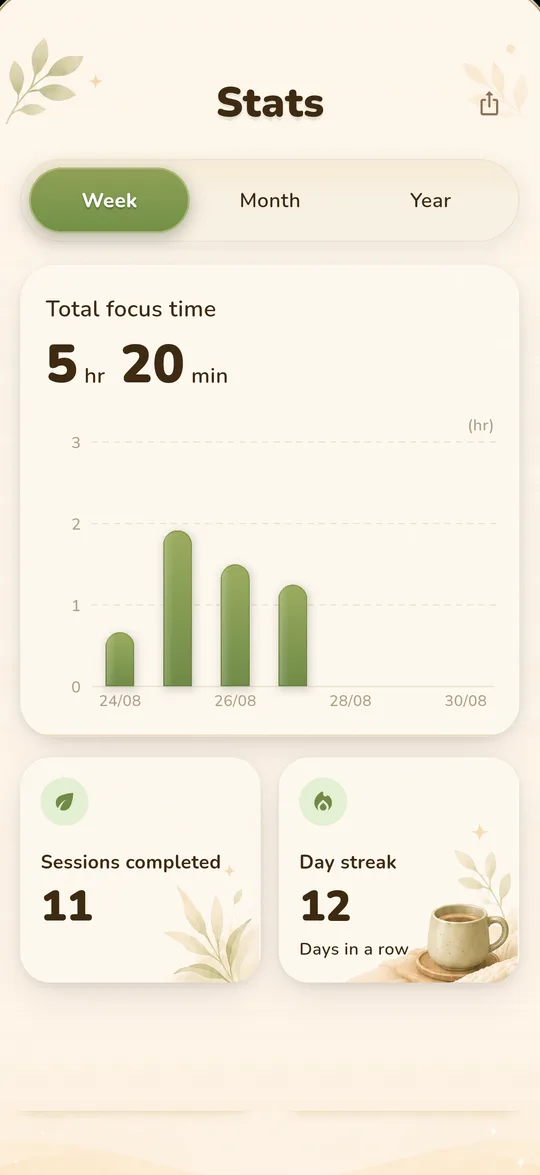
Study Corgi tracks the days you showed up, cushions a missed day with a streak freeze, and gives you something to come back to: a pet that reacts, and a room you build with the time you put in.
See how it works