Where the 25 minutes came from
Francesco Cirillo was a university student in the late 1980s, struggling to study for an exam. He made a deal with himself: ten minutes of genuine, uninterrupted work. He used a kitchen timer shaped like a tomato — pomodoro in Italian — and the name stuck.
The interval grew to 25 minutes because that was roughly the longest stretch he could hold without his attention drifting. That number is not a finding from neuroscience. It is one person's comfortable working length, which happened to be close enough to most people's that the method spread.
This matters, because people who try Pomodoro and fail usually blame themselves. They should be blaming the number.
What the method is actually doing
Three things happen when you start a timed interval, and only one of them is about time management.
1. It makes starting cheap
"Write the essay" is a task with no visible end. "Work on the essay for 25 minutes" ends at a known moment. The second is much easier to begin, and beginning is where most study sessions die. You are not committing to finishing; you are committing to 25 minutes.
2. It turns interruptions into a decision
When a thought arrives mid-interval — check a message, look something up, get water — the running timer forces a small, explicit choice: break the interval, or write the thought down and continue. Without the timer that choice is invisible, and you take the interruption without noticing you decided anything.
3. It gives the session an edge
Work with no boundary expands to fill the day and still feels unfinished. An interval that ends lets you register that something was completed. That completion is what makes the next session easier to start, which is the whole game.
The technique is not about being efficient for 25 minutes. It is about making the decision to start small enough that you actually make it.
Choosing your interval
Treat 25/5 as a starting guess, not a rule. Run it for a week and notice where your attention breaks.
- You drift at minute 12 to 15. Drop to 15/3. Short intervals are not a failure; they are the correct setting for a tired brain, a noisy room, or a task you are dreading.
- You are annoyed when the timer ends. That annoyance is the signal to go longer. Try 50/10. Deep work — writing, coding, mathematics — often needs 20 minutes just to load the problem into your head, and a 25-minute cap means you spend most of the session loading and almost none of it working.
- You cannot predict your day. Use a count-up timer instead. Start it, work, stop when you stop. You lose the boundary but you keep the record, which is still far better than nothing.
The break is part of the work
The most common mistake is treating the break as optional, or filling it with a phone. A break spent scrolling does not rest the same attention you were just using — it spends more of it. Then the next interval starts from a worse place than the last one ended.
Useful breaks are boring on purpose: stand up, look out of a window, get water, walk to another room. Five minutes of nothing in particular is what makes the fourth interval of the day feel like the first.
Handling the interruption you cannot ignore
Cirillo's rule was strict: an interrupted pomodoro does not count. That is good discipline and bad ergonomics — a rule people break once and then abandon entirely.
A gentler version that survives contact with real life: keep a scrap of paper next to you. When something arrives, write one line and keep going. If it genuinely cannot wait, stop the interval, deal with it, and start a fresh one. What you want to avoid is the third option, the one everyone actually does — half-handling it while the timer runs and calling that a focus session.
What to track, and what to ignore
Counting completed intervals is useful for about two weeks. After that it becomes a number you chase, and chasing it quietly pushes you toward easy tasks that fill intervals neatly rather than hard tasks that do not.
Better signals: how many days in a row you started at all, and whether the intervals are getting easier to begin. Consistency compounds; daily volume does not.

Want a timer that notices whether you finished?
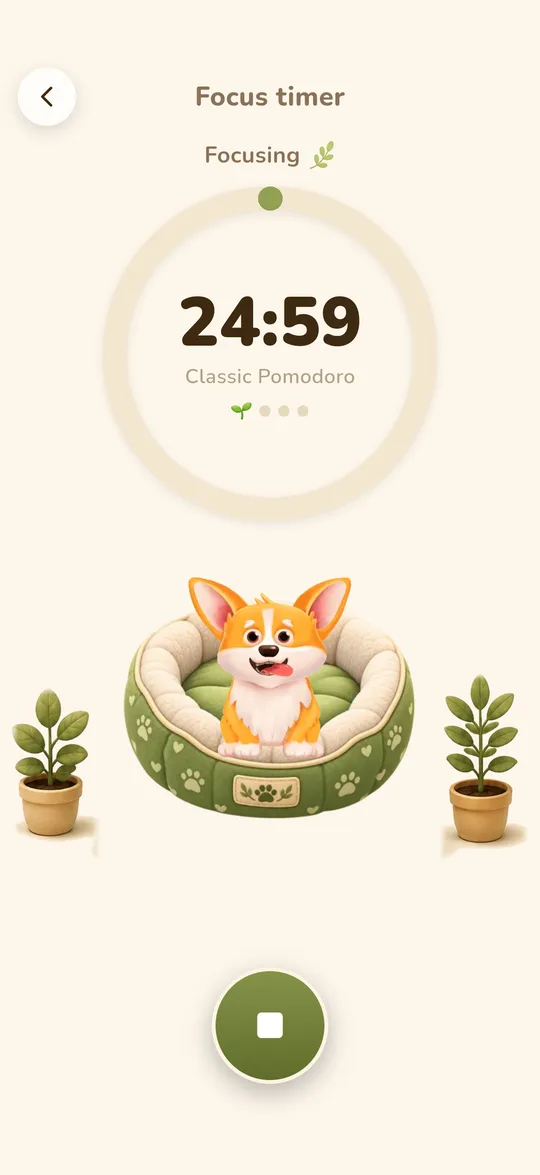
Study Corgi is a Pomodoro timer with a pet that reacts to your sessions — classic 25/5, a deep 50, count-up, or your own length. No ad ever appears while a session is running.
See how it works